
Discounting Is a Positioning Problem
 Ash Klemm
The Professional Standoff
Revenue growth is often treated as a volume game: more leads, more meetings, more proposals. But for many B2B leaders, the real bottleneck isn’t the top of the funnel: it is the erosion of value at the finish line.
If your team is constantly “sharpening the pencil” to get deals over the line, you aren’t experiencing a sales execution failure. You are witnessing a positioning failure. When a buyer asks for a discount, they aren’t necessarily telling you your price is too high: they are telling you your differentiation is too low.
- • Frequent discounting signals weak differentiation, not weak closing.
- • Most price pressure is a de-risking mechanism used by uncertain buyers.
- • Margin erosion signals that your value is not “decision-grade” internally.
- • Holding price requires outcome framing, tiered packaging, and specific proof.
If discounting keeps showing up, you are not “losing negotiations”, you are losing clarity. Buyers discount you when they cannot explain you. When the CFO asks, “Why them?”, and your champion cannot answer in one sentence, the safe move is to push on price.
“Most discount requests are not about price. They are about risk.”
The Hidden Psychology: Risk vs. Price
In B2B, the buyer is rarely spending their own money, but they are spending their own professional reputation. Every major purchase carries a heavy psychological weight: the risk of failure, the fear of wasted budget, or the potential for public embarrassment within the company. If your positioning is vague, the buyer simply cannot justify the “premium” to their board or CFO.
When the value isn’t obvious, price becomes the only measurable lever the buyer has to de-risk the decision. We see this play out across four specific dimensions of risk:
- Reputational Risk: If this project fails, how does it affect my career and future standing?
- Operational Risk: Will this disrupt our current workflows or cause long-term technical debt?
- Opportunity Risk: If we spend budget here, what other vital initiatives must we kill off?
- Financial Risk: Are we paying more than the market rate for a basic service?
A 10% discount isn’t just a saving: it is a buffer. It is the buyer’s way of saying: “If this project doesn’t work out as promised, at least I can tell the board I negotiated a lower price.” To hold your price, you must remove the perceived risk by proving your unique mechanism, not by lowering the cost.
The Real Cost Leaders Should Care About
A discount is a signal to the market that your price is a suggestion, not a standard. Once that signal is sent, you trigger a “Discount Death Spiral.” Procurement teams are trained to sniff out this lack of conviction: they learn they can win the commercial battle by simply waiting you out until the end of the month.
The damage to a B2B empire goes far beyond a smaller invoice:
- The Margin Squeeze: You fall into the trap of “Discount plus free extras.” You cut the price, but the client still expects the full scope. This leads to a delivery squeeze that burns out your best talent and kills your profitability.
- Wasted Executive Time: Low-clarity deals require more stakeholders, more “clarification” meetings, and more back-and-forth. You spend your most expensive senior hours defending a price that should have been locked in by your positioning.
- Unreliable Forecasting: When your pipeline is full of “deals with conditions,” your forecast accuracy vanishes. Leaders end up managing opinions and “gut feelings” rather than a reliable, repeatable revenue system.
- Brand Drift: you stop being the specialist and start being “one of the options.” You are no longer “the obvious choice” for a specific problem: you are just a vendor in a spreadsheet being benchmarked on hourly rates.
If you are serious about growth, discounting is not a sales training issue. It is a go-to-market control issue.
Why Discounting Happens: System Failures
1) Your differentiation is just “Entry Requirements”
In the trade, we often call the basics “table stakes”. These are the entry requirements you need just to be invited to the meeting. For an engineering firm, having qualified staff and insurance are not reasons to hire you: they are the bare minimum. If you build your pitch around these, you are telling the buyer you are a commodity. If you look like everyone else, you will be priced like everyone else.
2) The offer is framed as Activity, not Outcome
If your proposal reads like a list of tasks, the buyer benchmarks tasks. Tasks get benchmarked against cheaper competitors. Outcomes and risk reduction are harder to benchmark: that is where premium pricing lives.
3) You lack an “Owner’s Frame” of the problem
When you wait for the buyer to define the scope, you become a vendor. Vendors get shopped. Experts define the problem and the solution: this shifts the conversation from “how much do you cost” to “how do we fix this”.
4) The “Messy Middle” hasn’t been de-risked
Most B2B buyers aren’t afraid of your price: they are afraid of the six months of implementation chaos. If you haven’t shown them exactly how you navigate the implementation, they will discount you to compensate for that perceived stress.
The Profit Preservation Playbook
Restoring your margins isn’t about training your team to be “tougher” in negotiations. It is about installing a revenue system that makes your value undeniable before the price is even discussed. This 6-step playbook moves you from being a negotiable vendor to an essential partner: stopping the margin leak and accelerating your deal speed simultaneously.
Analyze your last ten deals where price moved. Write down exactly why it happened (e.g. “Buyer couldn’t justify fee to board”). Identify the two patterns that happen most often.
Can your champion defend your price in a one-paragraph email to their boss? If you don’t give them the specific language to justify your premium, they will ask for a discount instead.
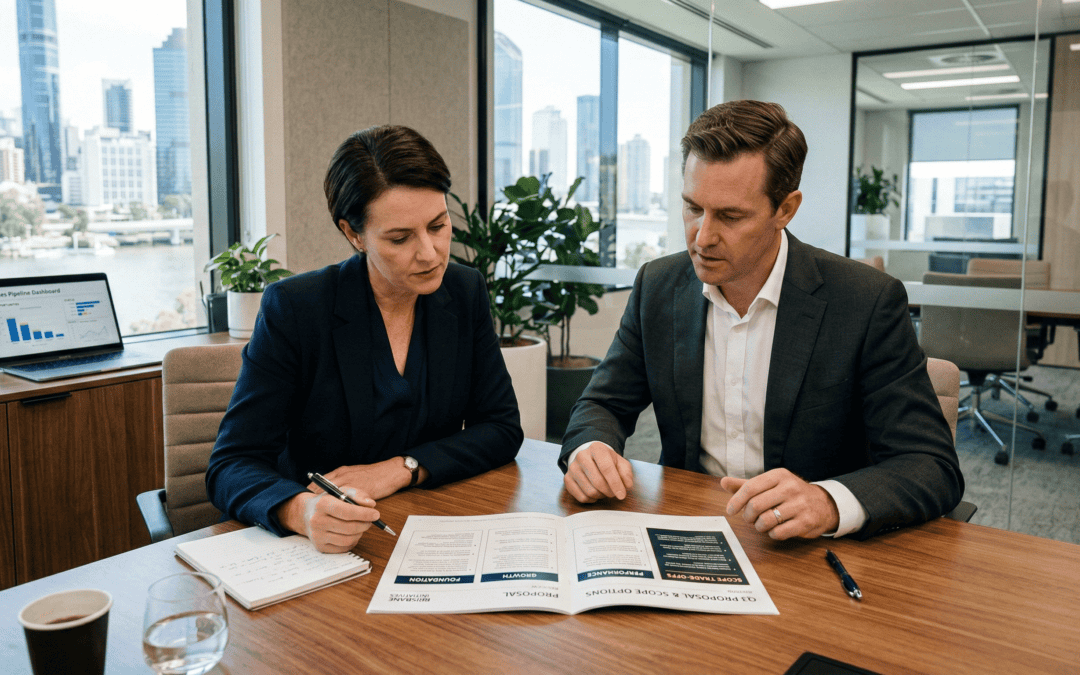
Stop sending bespoke numbers. Provide Foundation, Growth, and Performance tiers. Force the buyer to choose between scope and price, rather than just haggling over a single number.
If they need a lower cost, reduce the speed, the seniority of the team, or the volume of deliverables. Protect the integrity of your unit rate by changing the shape of the work.
Don’t just show results: show the mechanism of how you work. Most buyers fear the “messy middle” of a project. Show them your specific process to prove the project won’t fail.
Spend 30 minutes a week reviewing late-stage deals. Ask: What is the trigger for discount pressure? What shape change can we offer instead? This stops discounting from being a habit.
The Revenue System in Practice: Case Study
A Brisbane-based engineering firm was winning steady contracts but watching their margins erode through constant “late-stage adjustments” and free scope additions. The leadership team assumed the market had simply become more competitive: but the reality was a positioning leak.
We didn’t retrain the engineers to be sales people: we fixed the system. We packaged their technical expertise into three distinct tiers and built a conversion website strategy that proved their unique engineering mechanism months before the proposal hit the desk. Deals stopped stalling because the buyers finally had the language and proof to defend the premium price to their own boards. The result was a 14% lift in preserved margin within the first two quarters.
Stop the Margin Leakage
If your team is “sharpening the pencil” to win deals, you have a positioning gap. We can help you close it.
Let’s map your revenue system in a practical, 30-minute review and give you a 30-day fix plan to protect your profit.
Book Your Revenue Review